



Services
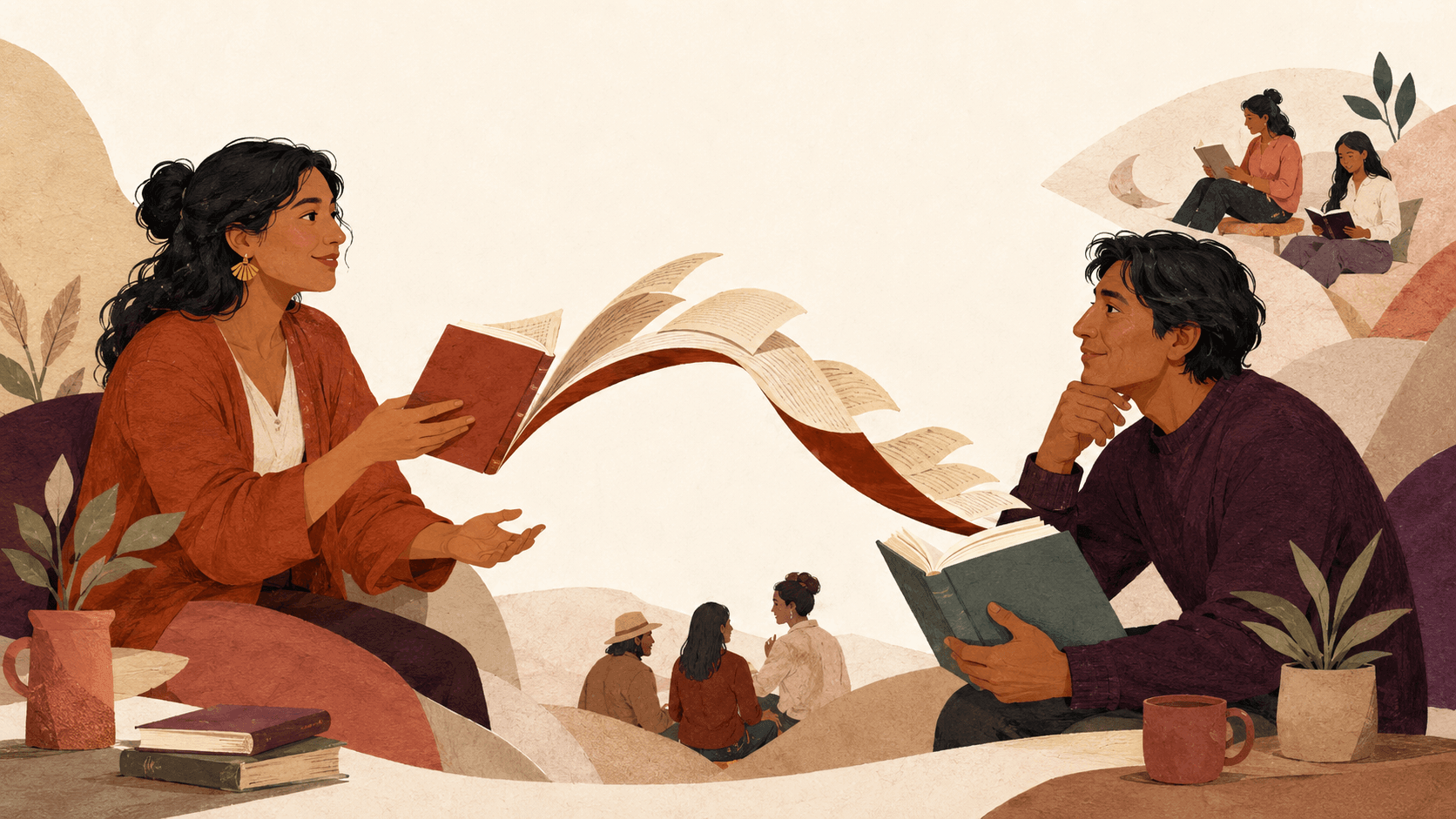
In Peru, there’s no shortage of stories. Nor is there a shortage of lists, catalogs, or rankings. However, for many people, it’s still difficult to answer a seemingly simple question: What book might I really enjoy?
The challenge isn’t always in getting your hands on a book. Sometimes it’s in choosing from too many options, finding a relevant recommendation, staying focused, or feeling like reading competes with more immediate obligations and distractions.
The 2022 National Reading Survey helps put this situation into perspective. 82.7% of the Peruvian population aged 18 to 64 read digital content, while 47.3% had read at least one book during the previous twelve months. Among the literate population in that age group, the average was 1.9 books per year, and among those who reported not reading books, 68.3% cited lack of time as the main reason.
These findings do not make cell phones the enemy of reading. Rather, they present an opportunity: if a significant portion of our attention is already focused on digital environments, technology can also serve as a bridge to books.
From that idea, Eliria was born—a digital initiative by APROS aimed at promoting reading through personalized recommendations, connections between readers, and an experience that helps users make better choices.
The project didn’t start with a list of features. It started with a conversation within the APROS team.
We brought together people with very different relationships to reading: frequent readers, people who read mainly for work, those who start books and then give up on them, and those who feel they simply haven’t found a story that can captivate them. We asked them two questions:
The responses revealed a problem broader than just a lack of discipline. They included difficulty concentrating, the habit of consuming short bursts of stimulation, boredom with books that are too long, lack of time, the obligation associated with school reading assignments, and the frustration of not knowing what to choose.
There were also some positive signs. Several people had discovered a book through a movie, a TV series, an anime, a video game, or a recommendation from someone they trusted. Others enthusiastically recalled discussing a book with friends, swapping books, or participating in a small book club.
The key finding was simple: many people don’t need to be told again that reading is good. They need to find a starting point that makes sense to them.
The project’s initial concept was called *Antología Viva*. Its goal was to ensure that visitors would read something worthwhile on their very first visit, through brief sessions lasting between one and ten minutes and a catalog that prioritized Peru and Spanish-speaking Latin America.
That phase allowed us to explore the issue from an editorial and legal perspective. If the app was going to publish texts, it wasn’t enough to simply find them for free on the Internet. It was necessary to verify the work, the edition, the translation, the digital source, the terms of reuse, and the attribution requirements.
That is why a methodology was designed to work exclusively with content in the public domain or under compatible licenses, preserve the literal wording of the texts, document their sources, and subject each translation to an audit. The principle was clear: culture cannot be promoted at the expense of the rights of those who create, edit, or translate it.
That research also revealed another insight: the reading experience begins before the first page. It begins when someone understands how long a text will take to read, how difficult it is, what they might find in it, and why it might interest them.
With each subsequent iteration, the project shifted its focus. Instead of trying to accommodate every possible reading choice, it began to concentrate on an earlier problem: helping each person find the right book and have a real reason to start reading it.
That’s how Eliria came to be—a name that combines the concepts of ” elixir ” and ” lyric“: a blend of stories, discovery, and human connection.
Eliria’s public promise is to connect each person’s profile with personalized, honest, and well-explained recommendations. All three words matter.
A recommendation is genuine when it comes from someone who has read the book and can share what they found in it.
She’s honest when she doesn’t just praise it. She also points out if it has a slow start, is quite long, uses challenging language, contains violence, has an open ending, or has any other feature that might put off certain readers.
And it makes sense when you don’t just say, “Read it,” but rather, “I think you might like it for this reason and at this moment.”
Average ratings help gauge the opinion of a large group of people. The “why,” on the other hand, helps us understand the context behind a recommendation.
Eliria’s model starts with a different question than traditional rankings: Which readers have similar reading tastes to yours, and which books worked for them?
To identify these similarities, the prototype takes into account much more than just literary genres. It explores:
Based on these signals, Eliria suggests ” mirror readers“: people with relevant similarities whose preferences may prove useful. The technology organizes the affinities, but the recommendation retains the voice and judgment of the person sharing it.
This approach breaks down a common barrier. A person doesn’t need to have a precise understanding of authors, movements, or genres to get started. They can begin with the stories that are already part of their life.
Eliria recognizes two equally important entry points: looking for your next read and recommending a book.
Someone who makes a recommendation doesn’t just list a title or assign it stars. They should indicate who it might be suitable for, what stands out about it, what challenges it might present, and why they think it’s worth reading. In this way, each recommendation becomes a small act of cultural mediation.
This design also avoids rigidly dividing users into “readers” and “experts.” The same person might come looking for guidance and, later on, discover that their experience with a book can help someone else.
The vision is to build a network in which readers’ knowledge does not depend solely on critics, influencers, or popularity algorithms. We can all contribute, as long as we explain our criteria honestly.
One of the most important discussions during the design phase was the use of challenges, rewards, and streaks. These mechanisms can encourage consistency, but they also run the risk of turning reading into yet another obligation.
Eliria doesn’t assume that every book must be finished. Putting a book down can be a valid decision and, moreover, a useful indicator for improving future recommendations.
That’s why the prototype includes statuses such as “I’m interested,” “I want to read it,” “I started it,” “I finished it,” and “It wasn’t for me.” The goal is not to judge a person’s performance, but to help them understand their own relationship with books.
Getting back into the habit can start with something small: finding a story that’s easy to get into, reading a few pages with interest, and wanting to come back to it. Progress matters, but it shouldn’t be built on guilt.
Eliria has a broad mission for the Spanish-speaking world, but it was founded with Peru as its priority.
This is reflected in the ability to search for Peruvian or Latin American literature, take into account the availability of books in the country, and connect readers within the local ecosystem. The goal is not to limit the experience to a specific territory, but rather to prevent local works from being hidden behind global catalogs and rankings dominated by the most widely publicized titles.
The proposal opens up new possibilities for readers, authors, publishers, bookstores, libraries, and literary mediators. A context-based recommendation can help a work be discovered based on shared interests, rather than solely on advertising spending or established popularity.
This vision aligns with the National Policy on Reading, Books, and Libraries through 2030, which recognizes reading as a right and a form of cultural participation linked to inclusion, the development of citizenship, and human development.
Eliria does not aim to replace schools, families, libraries, bookstores, book fairs, or reading mentors. Nor can it single-handedly bridge the economic or geographic gaps in access to books. Its contribution focuses on one specific goal: making the choice more meaningful, accessible, and guided.
The development of Eliria gained momentum during the 30th Lima International Book Fair. For APROS, participating in FIL Lima 2026 meant not only showcasing technology but also taking advantage of the opportunity to engage with readers and stakeholders in the publishing ecosystem to test hypotheses in a real-world setting.
One of the activities organized for the fair captured the spirit of the project: asking people to write the title of a book on a sticky note and, most importantly, the reason why they would recommend it.
The title identifies a work. The reason behind it reveals an experience.
That’s the difference Eliria aims to bring to the digital world. Behind every good book recommendation is a person who found something valuable and decided to share it.
APROS has been developing digital experiences and products since 2011. Eliria brings together expertise in research, strategy, user experience, development, data, and artificial intelligence, but channels these capabilities toward a cultural goal.
The project also reflects a guiding principle of our work: technology must address a specific problem. As we have noted when discussing strategic artificial intelligence, tools do not replace human judgment; rather, they enhance it when there is a clear purpose, data, and clear rules.
At Eliria, technology can help organize information, identify affinities, search metadata, and improve matches. However, it should not replace the personal experience that gives value to a recommendation.
That is why the project’s success will not be measured solely by registrations or downloads. What will matter is whether someone found a book they wanted to start reading, whether a recommendation proved useful, whether someone resumed reading without feeling judged, and whether a Peruvian work reached a reader who probably would not have discovered it otherwise.
Encouraging reading is a broad mission, but it can be broken down into very specific actions: making thoughtful recommendations, listening to what others like, recognizing that not everyone enjoys the same things, and helping people discover a story that’s right for them.
Eliria doesn’t require you to know anything about books to get started. It asks which stories have been a part of your life, what made you give up on others, and what you’re looking for today. Then it tries to connect you with people whose insights can help you.
Because sometimes, the next great book doesn’t appear on a bestseller list. It comes along when someone knows you well enough to say, “I think this story might be for you.”
Discover Eliria and find your next read. You can also recommend that book you’re still thinking about and explain why someone else should discover it.