



Services
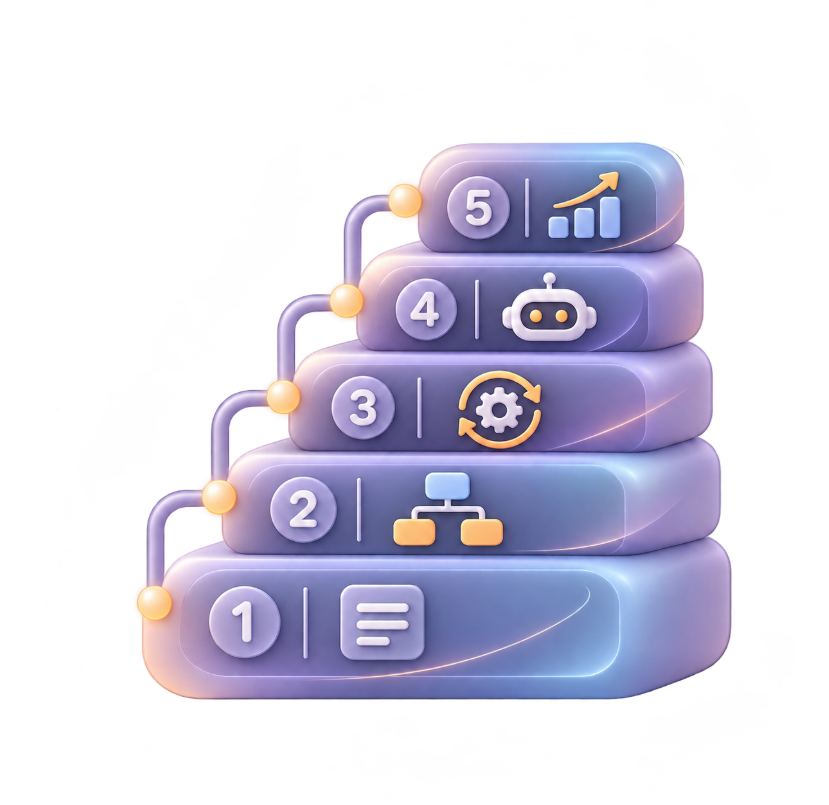
Automating a business does not mean implementing artificial intelligence overnight. Process automation can proceed in stages, starting with simple tasks and evolving toward systems capable of executing processes with greater autonomy.
Advancing through the levels of business automation helps reduce operational tasks and better connect processes.
Understanding the levels of business automation helps identify which processes can be optimized and how far each organization can progress.
Levels of automation represent the degree to which a task or process depends on human intervention.
At the initial levels, people perform virtually all activities. As automation increases, systems begin to perform tasks, link processes, analyze information, and, at more advanced stages, make certain decisions.
The goal is not to automate everything, but to use technology where it truly improves efficiency.
At this level, activities depend entirely on a person.
For example:
This model may work for small operations, but as volume grows, so do processing times, errors, and administrative tasks.
The first step toward business automation is usually to identify which of these activities are repetitive and time-consuming.
Here, technology assists the user, but the person continues to control much of the process.
A system can autocomplete information, generate alerts, prepare documents, or suggest actions.
This level makes it possible to reduce operational tasks without completely changing the way the company operates.
Implementing an ERP system can help streamline processes that have evolved independently. At this stage, the system can already execute sequences of tasks according to defined rules.
For example, when a user fills out a form, the system can record the information, send it to the CRM, assign it to a responsible party, and generate a notification.
Human intervention is primarily focused on exceptions or decisions that require judgment.
This level can lead to a significant improvement in operational efficiency.
At a higher level, different systems begin to exchange information and work in a coordinated manner.
For example, an ERP system can connect with inventory, sales, logistics, or customer service to keep information synchronized.
At this point, automation is no longer limited to a single task and begins to connect different areas of the company.
This reduces duplication and improves process traceability. Analyzing information and automating processes can help reduce manual work and improve management.
The most advanced level incorporates technologies such as artificial intelligence, machine learning, IoT, and data analytics.
These systems can analyze information, identify patterns, and perform certain actions automatically.
Some applications may include:
AI-driven automation makes processes more adaptive, but it requires a well-organized technological and data foundation. It is recommended to consider your industry, objectives, budget, and future needs before choosing a solution.
Not all companies need to reach the most advanced level right away.
Before implementing a solution, it’s a good idea to identify:
Proper automation means addressing a specific need, not adopting technology just because it’s trendy.
An effective process automation strategy can help:
Efficiency arises when technology eliminates unnecessary tasks and allows people to focus on higher-value activities. It’s not about choosing a well-known solution, but rather selecting one that aligns with the business’s actual goals and needs.
Automation doesn’t happen in a single step. Every company can move gradually from manual processes to connected, intelligent systems.
Identifying the current level allows companies to prioritize opportunities and use technology to make processes truly more efficient.
https://www.docusign.com/es-mx/blog/etapas-proceso-de-automatizacion
