



Services
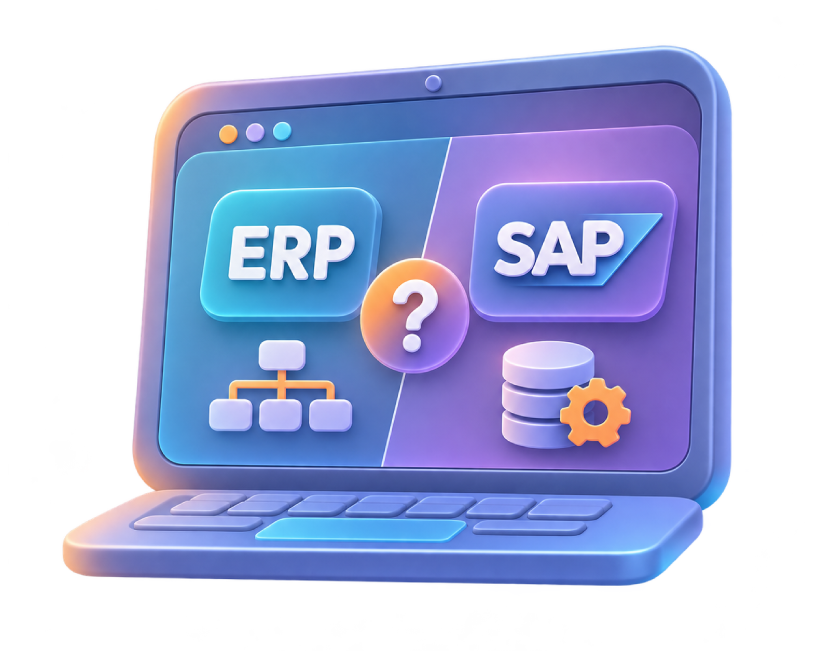
When a company needs to integrate information, automate processes, or better manage its operations, it’s common to come across terms like ERP and SAP. Although they’re often used as if they were the same thing, it’s important to understand the difference between ERP and SAP before choosing a solution for the company.
An ERP (Enterprise Resource Planning) is a type of business management software that allows different areas of an organization to be integrated into a single platform. SAP, on the other hand, is a company that develops various business solutions, including ERP systems.
In other words, SAP can be an ERP, but not all ERPs are SAP.
An ERP system allows you to centralize information and connect processes that may previously have been scattered across different programs, files, or areas of the company.
Depending on the solution, it can integrate processes related to:
One of its main benefits is that different departments can work from the same source of information.
In addition, ERP software can automate repetitive processes, reduce duplication, and facilitate access to the data needed for decision-making.
SAP is one of the best-known enterprise software providers on the market and offers solutions for managing various processes within an organization.
Its platforms can integrate areas such as accounting, logistics, human resources, production, inventory, and other business operations.
Therefore, when a company says it uses SAP, it is usually referring to one of the solutions that are part of its technology ecosystem.
A simple way to understand this is to think of ERP as a category.
For example:
ERP: a type of technology solution for managing business resources and processes.
SAP: one of the vendors that develops ERP solutions.
Therefore, a company that needs to implement an ERP system can evaluate SAP, but it can also consider other alternatives available on the market.
The decision will depend on each organization’s needs, size, processes, budget, and level of complexity.
Implementing an ERP system can help streamline processes that have evolved independently within a company.
Among its main benefits are:
Cibernos also highlights that ERP systems can integrate databases, reduce redundant processes, and improve management in areas such as logistics, human resources, finance, and the supply chain.
A company may begin evaluating ERP software when its processes can no longer be managed efficiently using separate tools.
Some signs may include:
In these scenarios, centralizing information and automating processes can help reduce manual work and improve management.
Not necessarily.
SAP is a well-known option in the ERP software market, but every company needs to evaluate which solution best fits its specific needs.
Before making a choice, it’s important to analyze aspects such as:
Cibernos points out that not all organizations need the same ERP and recommends considering the industry, objectives, budget, and future needs before choosing a solution.
Another important consideration is determining how much the company needs to adapt to the software and how much the software needs to adapt to its processes.
Some organizations can function effectively with a standard ERP solution. Others need integrations, specific modules, or custom software development to accommodate their unique operational processes.
That’s why, before choosing a platform, it’s a good idea to map out your current processes and determine which features are truly necessary.
Technology should help simplify operations, not create new obstacles in day-to-day work.
A proper implementation can enable you to:
The key lies not only in choosing a well-known brand, but in selecting a solution aligned with the business’s actual goals and needs.
The difference between ERP and SAP is that ERP is a type of enterprise resource planning system, while SAP is one of the vendors that offers this type of solution. The best choice will depend on each company’s specific processes, objectives, and actual needs.
Sources:
https://www.grupocibernos.com/blog/diferencias-entre-erp-y-sap
